The Bhaweshwar Das Center for Advanced Studies
The Bhaweshwar Das Center for Advanced Studies (BDCAS) is NAAMII's theoretical physics research center dedicated to advancing the mathematical foundations of quantum science and next-generation quantum technologies.
Through its two research areas,
- Algebraic Quantum Dynamics & Topological Informatics (AQDTI) and
Quantum Native Machine Learning (QNML)
the center develops rigorous mathematical frameworks for open quantum systems, quantum computing, non-Hermitian physics, and quantum-native AI algorithms, bridging fundamental theory with future quantum technologies.
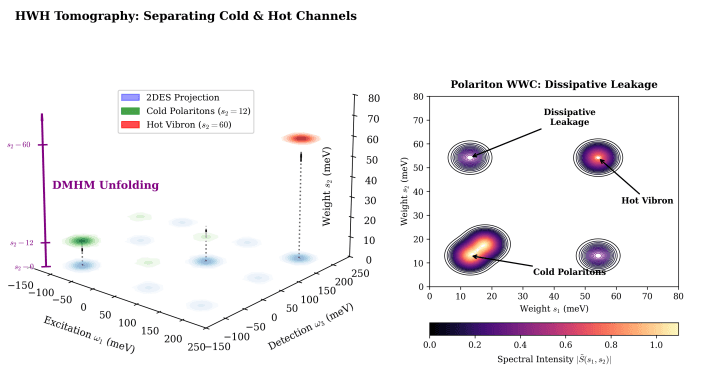
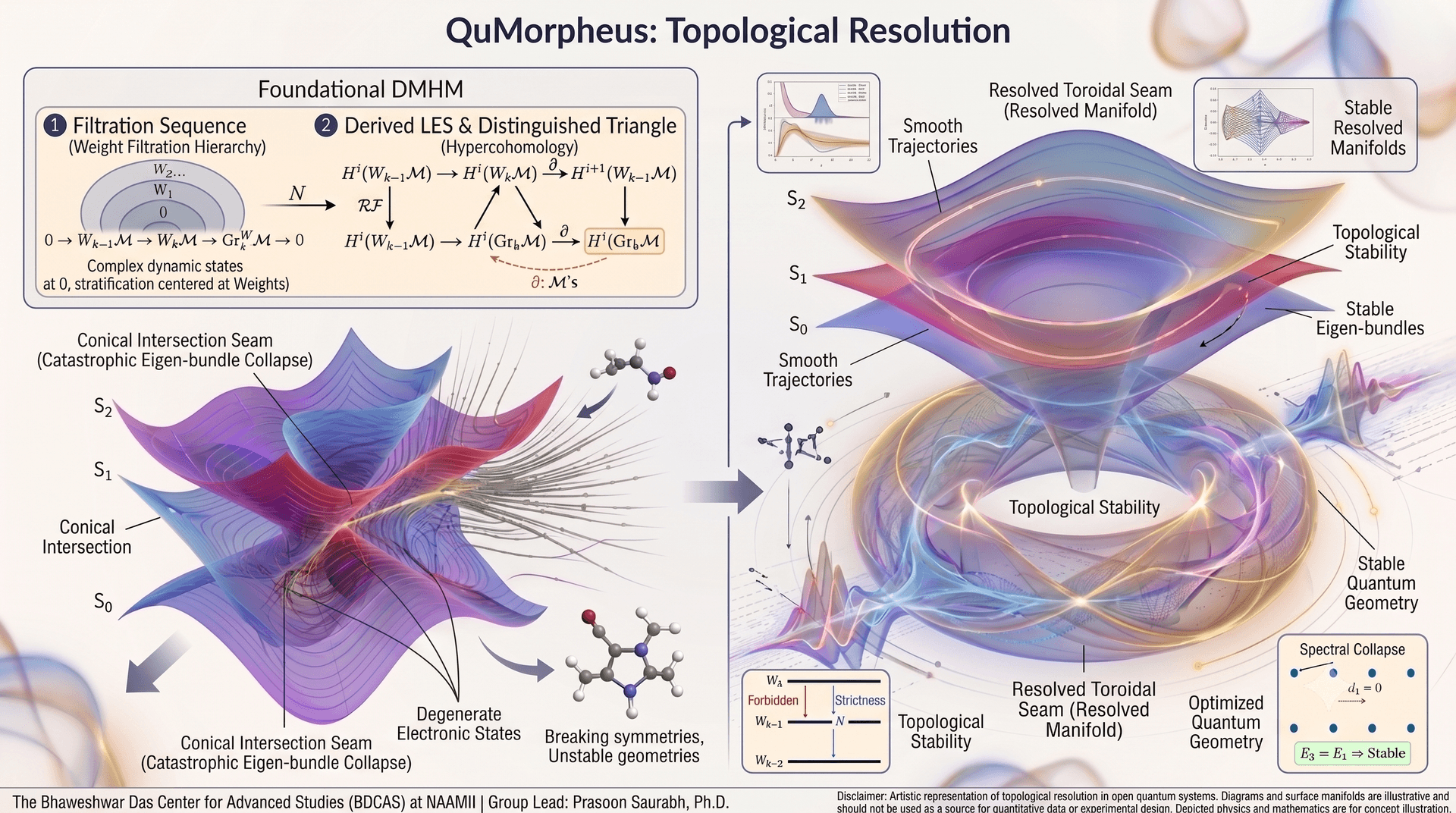
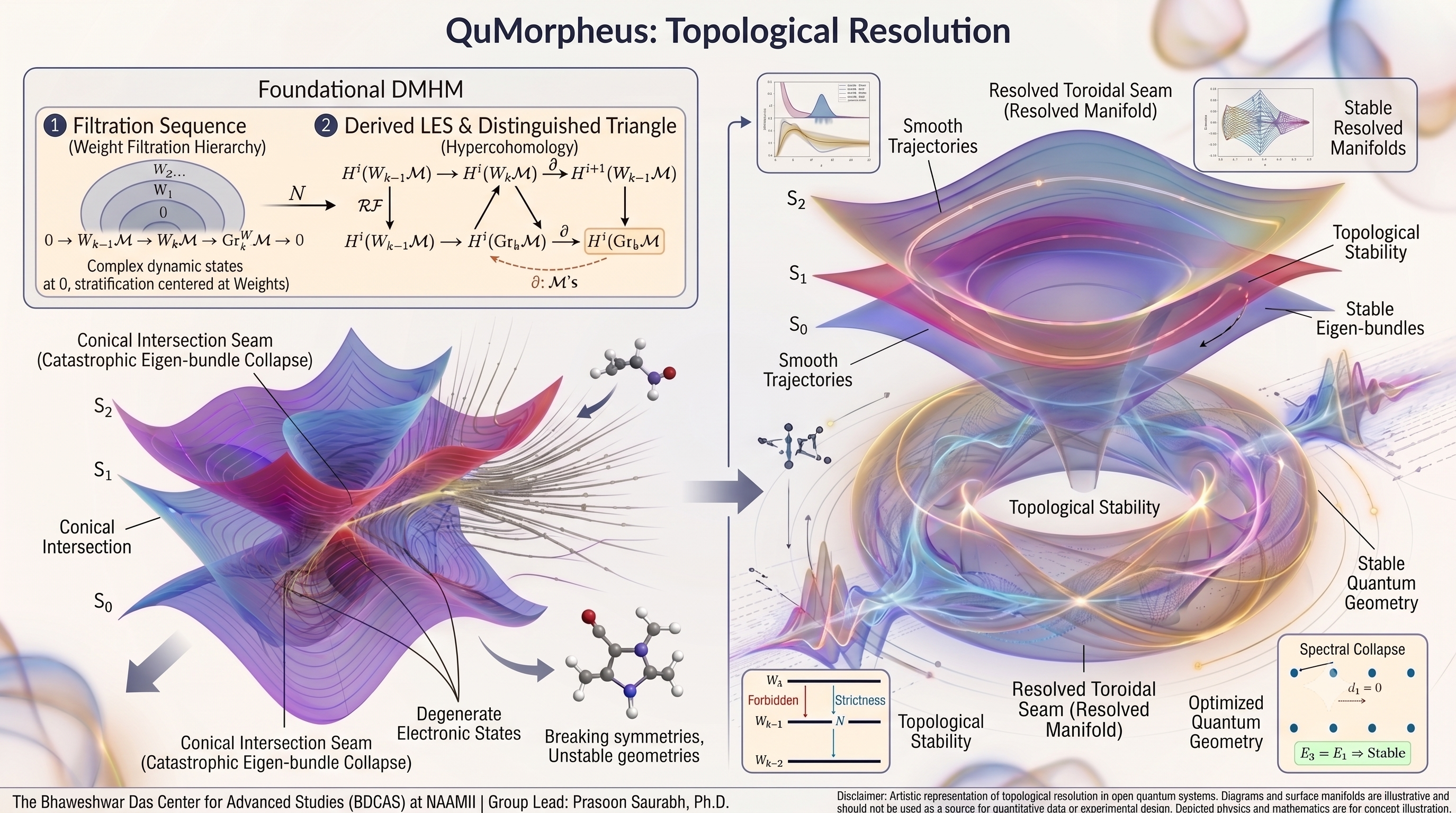
BDCAS pioneers the mathematical resolution of geometric singularities ranging from non-Hermitian exceptional points in open hardware to molecular conical intersections. By mapping continuous, noise-vulnerable quantum evolutions into exact topological counting problems, the center develops predictive frameworks like Dissipative Mixed Hodge Modules (DMHM) and Singular Natural Gradient Descent. These methodologies establish rigorous proofs for topological protection in gapless systems, advancing both fundamental quantum optics and the absolute optimization of macroscopic entanglement in quantum algorithms.
Department 1
ADQTI
Algebraic Quantum Dynamics & Topological Informatics
Advancing the Mathematical Foundations of Quantum Matter and Open Systems.
The Science
ADQTI focuses on the fundamental theoretical physics of open quantum networks and molecular systems. By mapping continuous, noise-vulnerable quantum evolutions into exact topological counting problems, the department develops predictive mathematical frameworks, such as Dissipative Mixed Hodge Modules and regular holonomic -modules. These methodologies establish rigorous proofs for topological protection in gapless systems and precisely model non-Hermitian evolutions where classical continuous assumptions fail.
Focus Areas
Department 2
QNML
Quantum Native Machine Learning
Probing Quantum Statistical Mechanics through Algorithmic Geometry.
The Science
QNML utilizes advanced algorithmic geometry to map the topological thresholds of complex, strongly correlated quantum systems. By elevating the internal geometric collapse of variational quantum circuits into direct physical observables, QNML mathematically proves that algorithmic barren plateaus and structural failures are strict topological footprints of physical capacity exhaustion. Utilizing Singular Natural Gradient Descent (SNGD) and exact anisotropic metrics, QNML resolves mesoscopic critical boundaries without the -damping that corrupts classical optimization.
Focus Areas