Building Tomorrow’s AI Innovators: NAAMII’s First AI for Schools Implementation at Adhyayan
- Post by: Naamii
- July 8, 2025
- No Comment
What happens when 9-year-olds start building neural networks instead of just learning what they are?
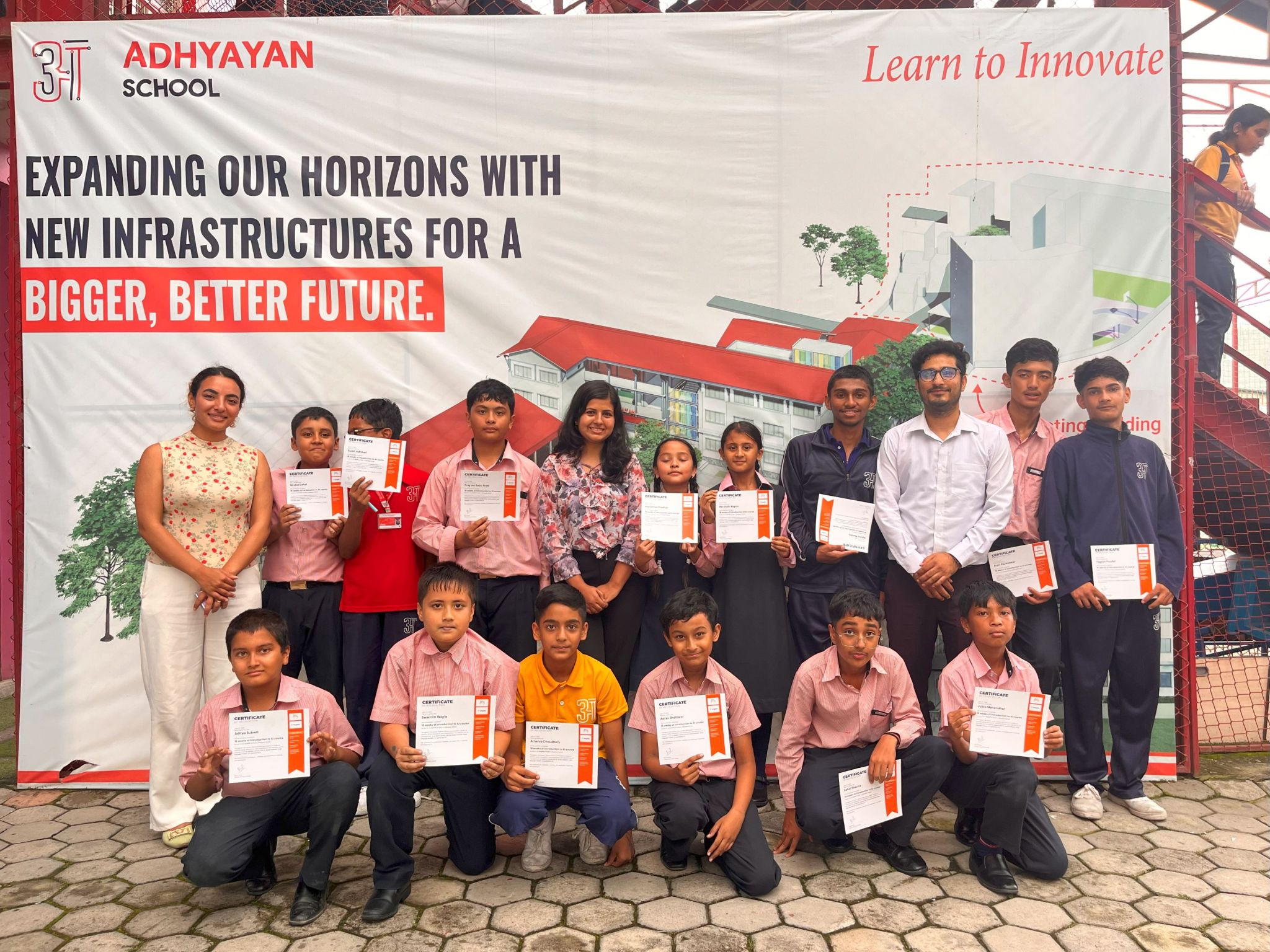
Through NAAMII’s Education Outreach Division, sixteen students aged 9 to 14 spent four months building AI systems for real problems in their school. Not just using AI tools; building with AI. They created classifiers, explored how neural networks work, and wrestled with bias in systems they designed themselves.
This wasn’t a curriculum about AI. It was a hands-on introduction to AI as a scientific discipline, a field students could explore, question, and apply with intellectual confidence. As a research institute advancing AI knowledge frontiers, we believe the next generation must move beyond passive use and develop the mindset of AI creators.
Our Radical Approach: Three Principles
When we launched our first AI for Schools implementation at Adhyayan School, we built it around three counterintuitive principles:
1. Start with real problems, not textbooks
Instead of beginning with “What is AI?” We asked students to identify issues in their school environment and explore how AI might help solve them. They proposed solutions for canteen hygiene monitoring, waste management, and exam supervision. From day one, they acted as problem-solvers rather than passive learners.
2. Build actual working systems, not demos.
Students developed real classifiers using Google Teachable Machine. They built a food recognition system for the cafeteria, an object detection model to count vehicles. These weren’t demonstrations; they were tools that students built, tested, and refined based on real performance. When something didn’t work, they had to figure out why.
3. Let ethics emerge from practice, not lectures.
Students wrestled with questions about training data quality, algorithmic bias, and responsible AI development; not as abstract concepts, but as immediate concerns about the systems they were building. “What if the AI makes mistakes about people?” wasn’t a theoretical concern: it was a genuine worry about systems they were learning to build.
What Surprised Us
After four months of implementation, three discoveries fundamentally changed how we think about AI education:
Fourth graders can understand neural networks
When we explained how neural networks process information, even our youngest students understood the basic idea of learning from patterns. They didn’t need to understand mathematics, but they grasped the fundamental concept of iterative learning. One fourth grader described it as “teaching a computer to get better at guessing by showing it lots of examples.” That’s not a bad definition of supervised learning.
Ethics come naturally through building
Students questioned their own systems. They learned about AI bias not through lectures but by watching their classifiers fail on edge cases and figuring out why.
Mixed-age teams can spark unexpected innovation.
Fourth graders working with ninth graders created approaches neither group would have developed alone. Younger students asked questions that revealed assumptions older students had missed.
The Transformation
By week sixteen, something fundamental had shifted. Students didn’t just understand AI; they began thinking about it. Faced with new problems, they naturally asked:
- What patterns could help solve this problem?
- What data would we need?
- How would we know if it worked?
- What would happen if we combined this with that other approach?
Students approached AI as collaborators, not as oracles. Rather than seeing AI as a black box that produces answers, they understood it as a system they could train, evaluate, and improve. They developed the confidence to question AI outputs and iterate on AI approaches.
Why This Matters
Most students will graduate high school having never encountered AI as anything more than a mysterious tool. They might use ChatGPT for homework or hear about machine learning in the news, but they’ll never engage with AI as a field of knowledge they can contribute to.
That’s the problem. We’re heading toward a future where AI literacy will be as fundamental as mathematical literacy.
Yet we risk creating a generation that relates to AI as consumers rather than creators: approaching it with wonder or wariness, but rarely with the confidence that they can understand its mechanisms, question its assumptions, or build something new with it.
As a research institute advancing AI knowledge frontiers, NAAMII recognizes that the next generation needs more than familiarity with AI tools. They need the intellectual confidence to engage with AI as a scientific discipline they can explore, question, and apply across whichever field they choose to work in.
What This Changes
This pilot showed us that students can engage with AI as original thinkers much earlier than expected. The key isn’t simplifying AI concepts, but providing authentic opportunities to build, question, and innovate with AI.
The students who participated in this program now approach AI with the confidence of insiders rather than the uncertainty of outsiders. They see emerging AI developments not as distant innovations, but as extensions of work they’re already doing.
The Future We’re Building
The goal isn’t just preparing students for an AI-driven world; it’s developing the original thinkers who will shape that world. These sixteen students represent the beginning of that effort.
They’ve become part of a generation that grows alongside AI advances, building experience and perspective that will serve them as the field continues to evolve. Most importantly, they’ve developed the intellectual confidence to contribute original thinking to AI development rather than just consume what others create.
In ten years, when these students are in universities and entering the workforce, they will not be learning about AI for the first time. They’ll be the ones teaching the rest of us what is possible.
Bring AI for Schools to Your Institution.
NAAMII’s AI for Schools program helps develop the next generation of AI creators and critical thinkers.
To learn more or bring this program to your school, contact our education team.